
How Creative Curriculum Supports Everyday Learning at The Growing Years Cary
Quick Answer
The Growing Years Cary uses Creative Curriculum, a structured, research-based approach designed by Teaching Strategies. For a parent, the name matters less than the experiences behind it: sensory exploration, communication, movement, problem solving, collaboration, and consistent family connection. The question worth asking is how those ideas connect to your child’s specific day — and what that looks like at different ages.
A Curriculum Gives Everyday Moments a Purpose
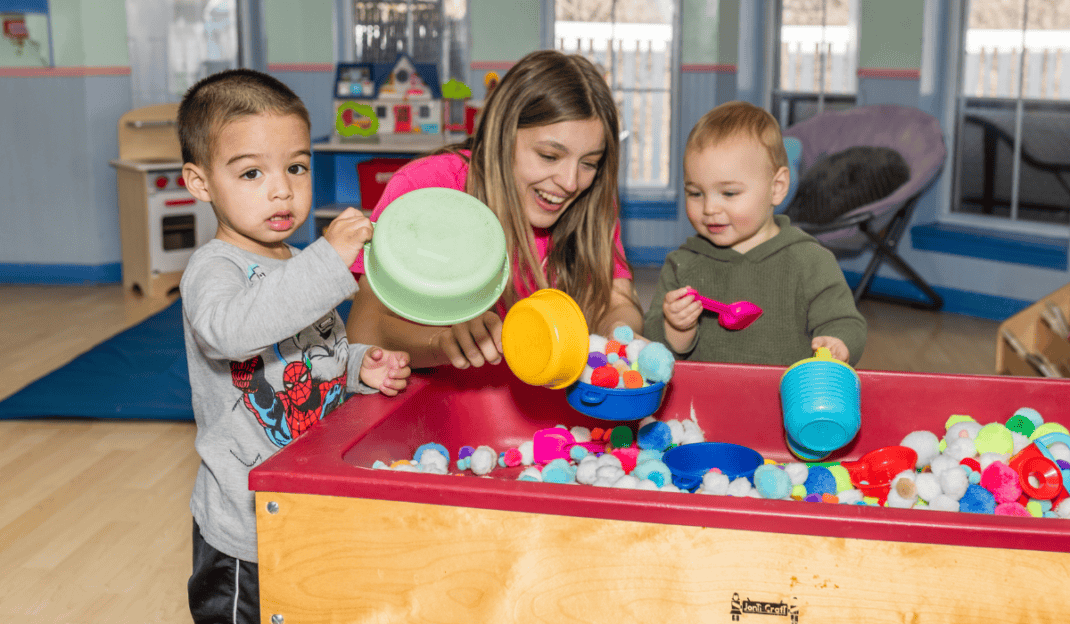
Young children learn through familiar moments. A baby feels the texture of something new and keeps reaching for it. A toddler tries to explain a big idea with a few words, a gesture, or a drawing. A preschooler has to decide how to keep a shared project going when a friend has a completely different idea about where it should go.
A thoughtful curriculum helps adults notice the learning inside those moments and build on it. It gives teachers goals to keep in mind while children are exploring, communicating, practicing, and trying again. Over time, those experiences can support skills across language, movement, problem solving, and cooperation — not as separate subjects, but as part of the same active day.
The Growing Years describes its approach as curriculum-based and focused on physical, social, emotional, communication, gross motor, fine motor, and problem-solving development. That range matters because a child’s growth is rarely contained in one kind of activity.
Children’s Interests Are Part of the Curriculum Too
A curriculum works best when it gives adults a way to be intentional without losing sight of the child in front of them. In the toddler program at The Growing Years, teachers observe and document children’s activities and interests. That is a meaningful detail for families because a toddler’s current fascinations often reveal where learning is already happening.
A child who keeps pouring water from one container to another may be practicing concentration, coordination, and vocabulary — and building persistence without anyone naming it as a lesson. A child who comes back to the same song again and again may be listening closely, moving with rhythm, and finding a reliable way to participate with the group.
The specific activity changes. What stays consistent is a teacher who notices, responds, and looks for the next opportunity to extend a child’s thinking.
What Learning Can Look Like at Each Stage
In the infant program, The Growing Years focuses on sensory, language, social-personal, and cognitive development. Babies learn through repetition, familiar people, and the chance to take in the world at their own pace. The materials and environment around them matter because they shape what a baby can safely see, hear, touch, and explore in a given day.
For toddlers, the center highlights expression through art, music, movement, and language. This gives young children several ways to communicate while their vocabulary is growing fast and their ideas are often bigger than their words. It also recognizes that a toddler may show an idea with their hands or their whole body long before they can explain it in a sentence.
In preschool, The Growing Years emphasizes an active role in learning, along with collaboration and cooperation. Children start to practice sharing an idea, listening to someone else’s perspective, and working through the small problems that come up naturally in a group — which, it turns out, is some of the most useful preparation for what comes next.
Staying Connected with Your Child’s Day
Families often want more than a general update at pick-up. They want enough context to respond when their child says “guess what I did today” or to share something that may matter the next morning.
The Growing Years describes daily conversations, email updates, messaging with teachers, and conferences in the fall and spring as ways families and the center stay connected. These touchpoints give families and teachers a chance to compare what a child is showing at school and at home — a connection that can be especially useful during a new routine, a developmental shift, or a change in family life.
During your tour, ask what those updates look like in practice for your child’s age group. It helps to understand the rhythm before enrollment so you know what to expect from the start.
Enrichment Programs Add More Ways to Explore
The Cary center offers Kids Kitchen, Tiny Picasso, Music Tunes, and Spanish as enrichment programs. Each gives children another way to use their hands, senses, language, creativity, or curiosity during the week.
Ask during your tour which offerings are currently available for your child’s age group and how they fit into the weekly schedule. That helps you picture the full shape of your child’s day without assuming every program runs on the same calendar.
Frequently Asked Questions
What does Creative Curriculum mean at The Growing Years Cary?
The center uses Creative Curriculum, developed by Teaching Strategies. Its published program descriptions connect that approach to development in communication, movement, sensory exploration, problem solving, and relationships across all age groups. A tour can help you see how those ideas show up in the setting and in your child’s actual day.
Will my child’s experience look different at each age?
Yes. The program descriptions reflect different emphases for infants, toddlers, and preschoolers. Infants are supported through sensory and early social development. Toddlers have opportunities to express ideas through art, music, movement, and language. Preschoolers practice collaboration, problem solving, and an increasingly active role in their own learning.
How can I know what my child is learning during the day?
The Growing Years describes several ways families can stay connected, including conversations at drop-off and pick-up, email updates, messaging with teachers, and conferences. During a tour, ask what those updates look like for your child’s age group and share the kinds of details that matter most to you.
Do enrichment programs replace classroom time?
The center describes enrichment as an additional part of the experience, with offerings such as Kids Kitchen, Tiny Picasso, Music Tunes, and Spanish. Ask about current availability and scheduling so you understand how these fit alongside your child’s regular classroom day.
Curriculum becomes meaningful when it helps a child feel engaged, understood, and ready to keep exploring. The best way to evaluate it is to connect what the center describes with the child you know — and to bring their interests, routines, and questions into the conversation when you visit.
Schedule a tour at The Growing Years Cary in Cary, North Carolina and see the program in person.
Related Posts
All Posts
What Does a Five-Star Rated License Mean for Cary, NC Families?

Planning Your First Visit to The Growing Years Cary: A Parent’s Guide
